Development
What Separates a Good Strategy From a Bad Strategy
Even Enggrav
Jun 24, 2026
About the Framework
Author: Richard P. Rumelt
First introduced: 2011, through the book Good Strategy / Bad Strategy
Key elements:
• Diagnosis - Defines the nature of the challenge. What’s really going on beneath the surface? This step turns vague problems into clear understanding.
• Guiding Policy - Outlines the overall approach for dealing with the challenge. It’s not a list of goals but a coherent direction.
• Coherent Actions - Specific moves that fit together and push the guiding policy forward. They connect intention with execution.
Why We Like It at BlueJam
• It separates real strategy from wishful thinking - no buzzwords, just clarity and choices.
• It reminds teams that strategy starts with diagnosis, not with a vision statement.
• It keeps focus: a few decisive actions done well beat dozens of half-measures.
Where It Can Fall Short
• It doesn’t prescribe how to find a good diagnosis - that part can be messy and subjective.
• Some teams stop at “guiding policy” and never get to coherent actions.
• It can feel too top-down if leaders don’t bring others into shaping the diagnosis.
BlueJam’s Take
BlueJam makes Rumelt’s logic chain visible and usable. Teams can test and share their diagnosis in one place, building a shared understanding of the real challenge. The guiding policy becomes a live narrative that everyone can see evolve, not a paragraph buried in a deck. Coherent actions link directly to people, timelines, and evidence of progress - so strategy moves from words to behaviors. The platform helps people connect daily decisions to the guiding logic, keeping the focus on what truly shifts the outcome.
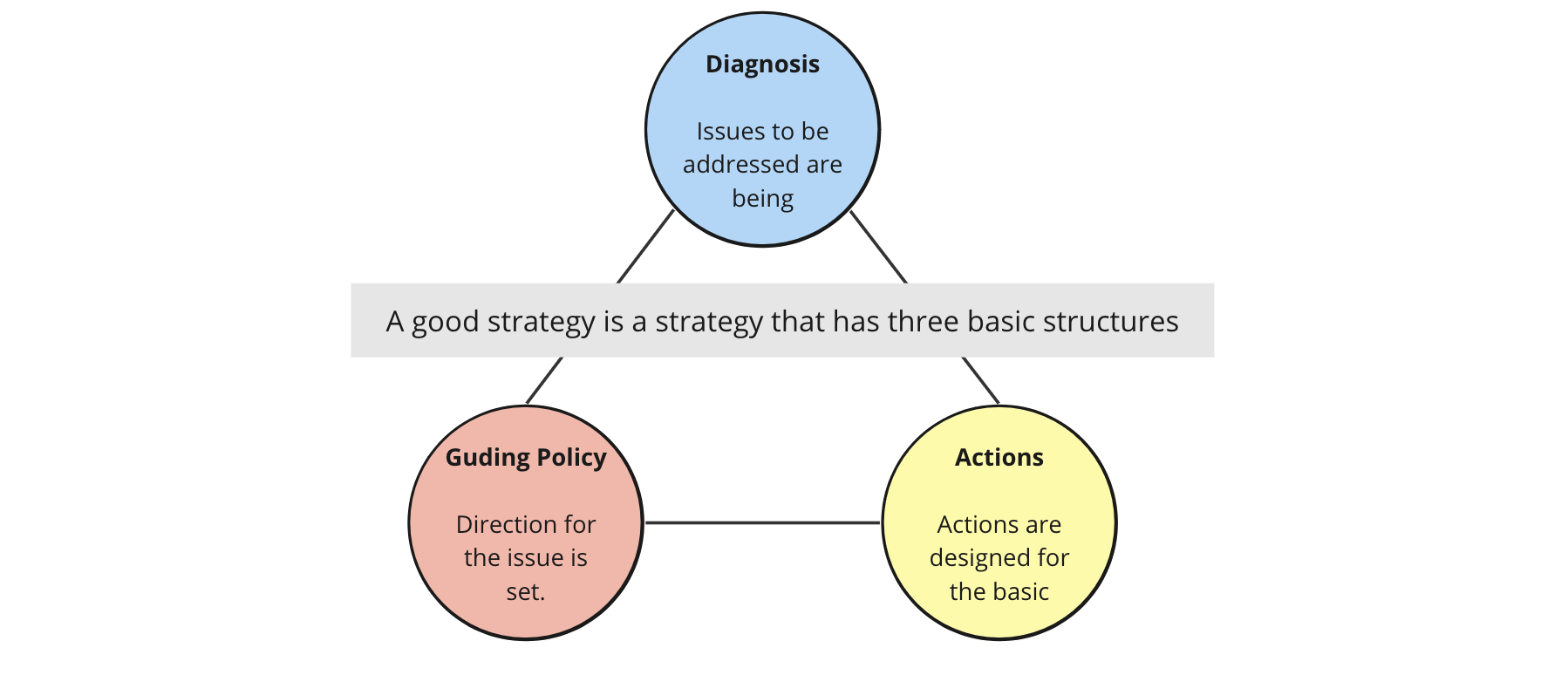
Image source: Richard P. Rumelt
From Bad to Good: How One Retailer Turned Its Strategy Around
When the leadership team at Northside Retail gathered for their annual offsite, the first slide read:
“Our vision: To be the leading retailer in our category through superior customer experience and digital transformation.”
Everyone nodded. It sounded inspiring. But when someone asked, “What exactly does that mean for us this quarter?” the room went quiet.
They had a list of big goals - launch an app, grow sales by 20%, expand into two new regions - but none of it explained why sales were slipping in the first place. It was, in Richard Rumelt’s language, a bad strategy: all ambition, no diagnosis.
So they stopped.
Instead of setting new targets, they spent a week digging into customer data and store visits. What they found surprised them. Competitors weren’t winning on price or marketing - they were winning on convenience. Shoppers could see real-time stock levels, reserve items online, and pick up the same day. Northside couldn’t.
That insight became their diagnosis: the real challenge wasn’t lack of growth; it was a broken customer experience caused by disconnected systems.
From there, a guiding policy emerged - make shopping effortless. Not “digital transformation.” Not “customer centricity.” Just a single idea: remove friction.
The team then aligned on three coherent actions:
Build a unified inventory system for all channels.
Retrain store staff to fulfill local online orders.
Freeze expansion until delivery speed and stock accuracy hit target.
It wasn’t flashy, but it worked. Within a year, delivery times dropped by 30%, customer satisfaction rose sharply, and sales recovered without opening a single new store.
Rumelt would call that good strategy - a clear diagnosis, a focused policy, and a few actions that fit together. No slogans required.

Even Enggrav
Customer Success Officer at BlueJam
Even is an experienced strategy execution expert with 12+ years of leadership experience from management consulting, specializing in strategic transformation and bridging the execution gap. He has helped Norwegian clients drive the strategic change agenda, while also coaching global operations teams in the Middle East, Africa, and Central America. He focuses on combining strategic depth with practical action to drive measurable impact and create sustainable outcomes.
Related Articles

Must-Win Battles - Focus Strategy on What Matters Most
When everything feels like a priority, Must-Win Battles bring clarity. This framework helps teams focus on the few strategic fights that truly matter.
Read more

Playing to Win - A simple way to make strategy about real choices
"Playing to Win” turns strategy into a series of bold, connected strategic choices: defining where to play, how to win, and what it truly means to succeed. It’s a practical approach that makes strategy clear and focused
Read more
Experience the world’s most fun and engaging strategy platform for all employees.
A big claim? Try it yourself and see what you think.
The world’s most fun and engaging strategy platform for all employees.
Follow us