Execution
Strategy Execution Frameworks, Simplified: The Three Core Ingredients
Even Enggrav
Jan 12, 2026
The Illusion of Unique Frameworks

As seasoned strategy practitioners, my colleagues and I have seen the full spectrum of implementation methodologies: Must-Win Battles, OKRs (Objectives and Key Results), the Balanced Scorecard, Hoshin Kanri, and countless proprietary systems.
Each framework comes with its own vocabulary and claims of uniqueness. While there are structural differences, I’ve observed that the key concepts are rarely as disparate as their proponents suggest. The core issue, time and again, is not a flaw in the framework but its misuse—getting lost in bureaucratic overhead. The truth is much simpler:
All proven strategy implementation frameworks, when stripped down to their functional core, are built upon the same three fundamental ingredients.
My experience has taught me to distill these approaches into a single, potent logic. This logic is clear, linear, and brutally effective because it answers the three fundamental questions every organization must address to successfully translate strategy into market reality.
The Three Core Ingredients of every Strategy Execution Framework
Ingredient 1: What Do We Want to Achieve?
This ingredient represents the specific, articulated goal that has been translated and broken down from the core strategy. It is not the core strategy itself, but the immediate, actionable output required for execution.
Whether you label it an Objective, a Goal, a Priority, a Must-Win Battle, or an Ambition, the function is identical: It defines the specific, impactful outcome required in a given cycle (e.g., quarter or year). This element must be compelling and strategically linked to competitive advantage. If your objective is vague, your effort will diffuse into generalized activity.
You should ensure clarity on this objective first; it is the starting point for execution.
Ingredient 2: How Do We Measure Success?
Intentions are meaningless without verifiable results. This ingredient introduces accountability and focus by esta
blishing the unambiguous, quantifiable metrics that prove Ingredient 1 has been achieved.
This involves defining your KPIs (Key Performance Indicators), Key Results, Result Indicators, or Performance Measures. Successful execution demands moving from activity to results. We encourage defining both leading indicators (predictive measures) and lagging indicators (final results) to gauge progress accurately.
You must establish what the "target" looks like; the measure is the definition of success.
Ingredient 3: What Do We Need to Do to Succeed?
Strategy execution fails when the link between the desired outcome and the work required is unclear. This ingred
ient encompasses the Initiatives, Projects, Actions, and Tasks—the work itself.
These are the specific, high-leverage activities that must be executed. The most critical requirement here is that these actions must directly link back to and enable the achievement of Ingredient 1 (the Objective). While many initiatives will directly influence a measure (Ingredient 2), you must recognize that not every action can or needs to be perfectly measurable by a KPI. Some critical initiatives—like cultural shifts or exploratory projects—are tied directly to the goal, and their success is validated upon achieving the overall objective.
You should focus capital and capacity only on the vital few initiatives that demonstrably move the needle toward your objective.
The BlueJam Perspective: Mastery Through Simplicity
When strategy stalls, we've found it's almost always a failure to establish crisp, causal linkages between these three core ingredients.
Leaders who succeed move past the framework’s name and master the underlying logic. They recognize the universal engine:
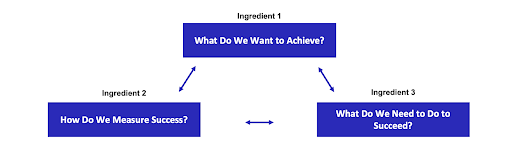
By focusing on the causal flow and the quality of the definition at each stage, we help organizations build a resilient execution culture. We empower leaders to simplify, align, and act with confidence—because the best strategy is the one that actually gets implemented.
Three Take-Aways
Dismantle the Jargon: Recognize that all implementation frameworks share a universal logic: Objective, Measure, Action. We advise you not to confuse the complexity of the system with the simplicity of the strategy. Focus on the clarity of these three core ingredients.
Anchor Actions to the Goal: The primary strategic requirement for any initiative (Ingredient 3) is that it must directly enable the achievement of your Translated Objective (Ingredient 1). Rigorously test this link, even if the action doesn't have its own dedicated, immediate KPI.
Define "Success" Quantitatively: A common failure point is a vague measure. You must move beyond "improve customer satisfaction" to "increase the Net Promoter Score (NPS) from 45 to 60 by Q4." Success must be numerical and undisputed where possible.

Even Enggrav
Customer Success Officer at BlueJam
Even is an experienced strategy execution expert with 12+ years of leadership experience from management consulting, specializing in strategic transformation and bridging the execution gap. He has helped Norwegian clients drive the strategic change agenda, while also coaching global operations teams in the Middle East, Africa, and Central America. He focuses on combining strategic depth with practical action to drive measurable impact and create sustainable outcomes.
Related Articles
Managing Alliances with the Balanced Scorecard
Fifty percent of corporate alliances fail. But you can increase your partnership’s odds of success by applying these techniques - by Robert S. Kaplan, David P. Norton, and Bjarne Rugelsjoen
Read more

Beyond OKRs: How Teleplan Took Strategy to the Next Level
When Microsoft announced the end of Viva Goals, Teleplan didn’t just look for a replacement - they wanted an upgrade. The move to BlueJam was like trading in an old car for a BMW: smoother drive, faster performance, and a system built for the road ahead.
Read more
Experience the world’s most fun and engaging strategy platform for all employees.
A big claim? Try it yourself and see what you think.
The world’s most fun and engaging strategy platform for all employees.
Follow us